

We're delivering for net zero
Our biggest contribution to the net zero transition is through the accelerated scale-up of renewable energy generation, providing the low carbon energy needed to power decarbonised economies and removing our reliance on fossil fuels.
Our approach to tackling climate change is aligned with SDG13 – Climate Action – and the SSE Group target to cut carbon intensity by 80% by 2030. Through our Net Zero Acceleration Programme (NZAP+), we aim to increase our installed renewable energy capacity to 9GW by 2027, and over 16GW by 2032.
At the same time, we are taking action to decarbonise our own operations and supply chain – decoupling greenhouse gas emissions from business growth.
CO2e avoided through renewable energy generation
Net Zero Transition Plan
We published our Net Zero Transition Plan at COP28 in December 2023.
This sets out our shorter-term (to 2030), medium-term (to 2035) and long-term (to 2050) science-based carbon reduction targets to reduce scope 1 and 2 greenhouse gas (GHG) emissions from our operational activities, as well as scope 3 GHG emissions in our supply chain.
Our Net Zero Transition Plan also outlines the headline actions we'll take to address the ’hotspots’ within our business carbon footprint.
This includes action to tackle greenhouse gas emissions from the fuels and materials – such as steel and concrete – used in the construction and operation of renewable energy developments.
We will report on progress against these targets and actions via our annual sustainability reports.
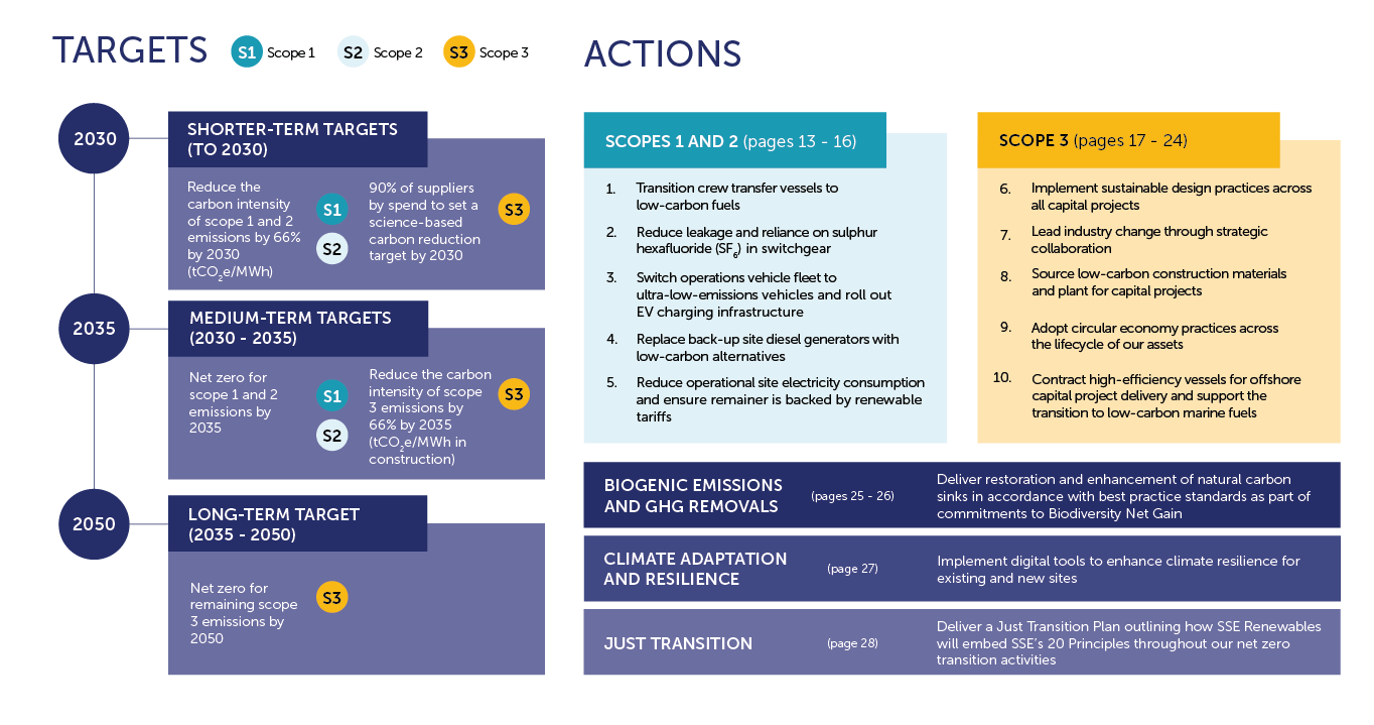
Overview of Progress Against Our Net Zero Targets FY2023/24
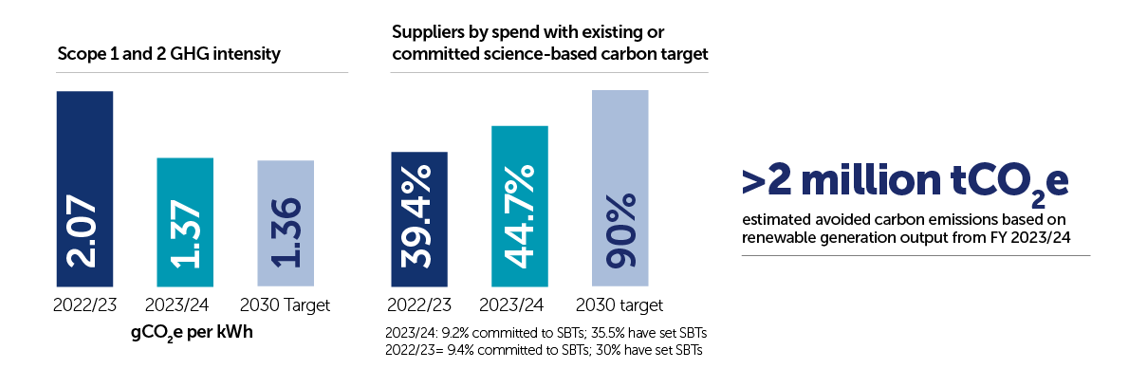
For a full progress update on our performance against our Net Zero targets and actions please see our latest Sustainability Report.
Net Zero
Decouple growth from increased carbon emissions
The biggest contribution to the net zero transition SSE Renewables makes is through the accelerated scale-up of renewable energy generation, providing the low carbon energy needed to power decarbonised economies and removing our reliance on fossil fuels.
SSE Renewables’ operational portfolio comprises a diverse range of onshore wind, offshore wind, hydro, solar and battery storage assets. In 2024/25, SSE Renewables’ operational capacity increased from 4.5GW from 5GW. This was driven primarily by the on-time, on-budget delivery of the Viking onshore wind farm but also includes the significant milestones of SSE Renewables’ first GB battery energy storage system site and first European onshore wind site coming online. This resulted in SSE Renewables generating 10,168GWh of renewable energy (including pumped storage and battery and excluding constrained-off GB wind), which corresponds to over two million tonnes of carbon dioxide equivalent of avoided emissions, through the displacement of more carbon-intensive forms of generation in the grid mix.
As SSE Renewables plays its role in the transition to a clean energy system through the generation of renewable energy, the company is also taking action to address its own business carbon footprint at the same time. It is doing this by investigating the technologies and practices required to reduce greenhouse gas (GHG) emissions across the lifecycle of its assets. In 2024/25, SSE Renewables’ Scope 1 and 2 GHG emissions intensity experienced a slight increase but remains well-below power sector norms. With the Scope 3 GHG intensity has fallen relative to previous years but will likely fluctuate on a yearly basis with changes to capital expenditure and continued improvements to sourcing supply chain GHG emissions data.
Our goals
Reduce the carbon intensity of Scope 1 and 2 emissions by 66% by 2030
Goal 1 +Reduce the carbon intensity of Scope 1 and 2 emissions by 66% by 2030
Goal 1Scope 1 and 2 GHG intensity (gCO2e/kWh)
22/23 – 2.07
23/24 – 2.74
24/25 – 2.97
2030 target – 1.36

90% of suppliers by spend to set a science-based target by 2030
Goal 2 +90% of suppliers by spend to set a science-based target by 2030
Goal 2Suppliers who have set or committed to SBTs
22/23 – 39.4%
23/24 – 44.7%
24/25 – 39.4%
2030 target – 90%
Scope 3 GHG intensity (tCO2e/MW in construction)
22/23 – 507
23/24 – 463
24/25 – 440
Commitment
Transition crew transfer vessels to low-carbon fuels
Progress
SSE Renewables continues to monitor the market for innovations that have the potential to reduce the carbon emissions associated with crew transfer vessels (CTVs) deployed on its offshore wind farms. In 2024/25, one such novel technology was EcoPro’s hydrogen electrolyser that has the potential to be retrofitted onto existing CTV engines to provide reductions in fuel consumption and emissions. This technology was tested through the Low Carbon Power and Energy Partnership (a research collaboration between SSE, ScottishPower and Strathclyde University to investigate low carbon technologies) and showed promising results. Further work may be conducted to carry out additional performance testing on EcoPro’s technology.

Commitment
Reduce leakage and reliance on sulphur hexafluoride (SF6) in switchgear
Progress
SSE Renewables continues to engage with switchgear suppliers on the commercial and technical viability of alternatives to SF₆ and the timeline for their availability. As of 2025, availability of non-SF₆ switchgear models for the applications used by renewable generation projects remain limited. This is expected to change in coming years with manufacturers outlining roadmaps to help the industry meet the updated EU F-Gas Regulations. Where SF₆ alternatives are currently available, SSE Renewables have requested suppliers provide these in tenders for its projects.

Commitment
Switch operations vehicle fleet to ultra-low-emissions vehicles and roll out EV charging infrastructure
Progress
As part of the wider SSE Group, SSE Renewables is committed to the EV100 pledge to move to an electric vehicle fleet by 2030 and is continuing to take action to address barriers to uptake. This has included installing EV charging infrastructure at operational sites, with 24 11kW charging bays installed and commissioned across 7 operational hydro sites and a further 7 onshore wind sites being assessed. For new sites entering construction, a requirement to assess the need for EV charging infrastructure has been included as part of Employer’s Requirements.

Commitment
Replace back-up site diesel generators with low-carbon alternatives
Progress
SSE Renewables is examining ways in which fossil fuel usage can be further reduced, with back-up diesel generators that are typically deployed on onshore wind and hydropower during construction and maintenance being a key target to replace. With highly variable requirements over SSE Renewables’ onshore and hydropower fleets for back-up power, a data-driven approach to selecting the most appropriate low impact alternative technology is being developed. In collaboration with advanced propulsion research and innovation centre IAAPS, SSE Renewables is defining a series of laboratory-based tests to quantify the cost and sustainability metrics of alternative generator technologies and low/zero impact fuels. The data from such testing will enable SSE Renewables to make informed decisions on which technology and fuel type to deploy in lieu of diesel generators.

Commitment
Reduce operational site electricity consumption and ensure remainder is backed by renewable tariffs
Progress
Though SSE Renewables’ sites are net exporters of electricity, it is investigating ways to further reduce the carbon impact of the limited fraction of electricity they consume during the course of normal operations. As the grid decarbonises, through the growth of renewable generation, the carbon intensity of this electricity consumption is reducing and expected to reach near zero in the 2030s. Until then, SSE Renewables is covering its electricity consumption with market-based solutions such as renewable energy tariffs.

Commitment
Implement sustainable design practices across all capital projects
Progress
Over 2024/25, SSE Renewables has continued to improve its Sustainability Assessment & Action Plan (SAAP) process across its large capital projects. This has included updated guidance around climate risks and opportunities to support decision-making by project teams. The early identification of these risks and opportunities helps project teams find ways to incorporate them into design and procurement processes, thereby embedding carbon reduction into the earliest stages of project development in accordance with the principles of the PAS 2080 – Carbon Management in Infrastructure – standard.

Commitment
Lead industry change through strategic collaboration
Progress
Through the Carbon Trust’s Sustainability Joint Industry Programme (SusJIP), SSE Renewables has continued to support delivery of a decarbonisation pathway for the offshore wind sector. SusJIP has now moved into phase 2 where the programme is focused on standardising supplier emissions data and engaging with policymakers on opportunities to increase uptake of low-carbon technologies.
Commitment
Source low-carbon construction materials and plant for capital projects
Progress
Steel and concrete represent a significant portion of the embodied carbon in renewable projects. Decarbonisation of the steel sector will require investment in new production plant and the right policy framework. To address the commercial barriers hindering the development of cost-effective low-carbon steel, SSE Renewables have been undertaking policy advocacy over 2024/25, including responding to consultations such as providing input into the UK government’s steel strategy and the EU Steel & Metals Action Plan.
Case study
Onshore wind turbine foundations are significant engineering structures requiring a considerable volume of concrete and steel in their construction. These materials produce high emissions of carbon dioxide equivalent (CO2e) during their manufacture and make up a significant proportion of SSE Renewables’ scope 3 emissions. As a result, the business is exploring ways it can reduce this impact. Over 2024/25, SSE Renewables worked in collaboration with Mott MacDonald, one of the business’s key contract partners, to better understand how it can move towards net zero foundations. To do this, it looked at the carbon impact of two core elements: the materials and the overall foundation design philosophy. Lower-impact concrete mixes and using composite reinforcing bars, rather than traditional steel bars, were investigated as options to address emissions from materials. The work concluded that whilst lower-impact materials could reduce the embedded carbon in a foundation, the overall design philosophy can have a much greater impact. The findings of this study will support the design specification of SSE Renewables’ future onshore foundations, leading to savings of embodied carbon on the future onshore fleet.

Commitment
Adopt circular economy practices across the lifecycle of our assets
Progress
Adopting a circular approach to the life cycle of renewable energy assets is a central element of how SSE Renewables aims to reduce its business carbon footprint. To build the industry needed to support a truly circular economy, SSE Renewables have taken a leading role in partnerships like the Coalition for Wind Industry Circularity (CWIC) and has been working closely with supply chain partners to reduce embodied carbon by refurbishing, instead of replacing, assets where commercially and technically viable.

Commitment
Contract high-efficiency vessels for offshore capital project delivery and support the transition to low-carbon marine fuels
Progress
Maritime greenhouse gas emissions from supplier vessels comprise nearly 40 percent of SSE Renewables’ Scope 3 emissions. To better understand and influence the decarbonisation pathways for maritime fuels, SSE Renewables joined the International Marine Contractors Association (IMCA) Energy Company Forum in 2024 and are actively engaging on policy developments which can stimulate the uptake of low-carbon technologies on vessels used by the offshore wind sector.
In 2024/25, SSE Renewables undertook technical assessments of hybrid-electric SOV technologies to inform future low-carbon operations at offshore wind farms. As part of this, the technical maturity and risks of various in-field charging technologies were studied. This helped inform an understanding of the constraints around integrating them into offshore wind farms and the commercial models that may need to be adopted to support uptake of these technologies.

Commitment
Deliver restoration and enhancement of natural carbon sinks in accordance with best practice standards as part of commitments to Biodiversity Net Gain
Progress
SSE Renewables’ approach to reducing biogenic emissions from land use is integrated with its Nature Positive approach to habitat management.

Commitment
Implement digital tools to enhance climate resilience for existing and new sites
Progress
Climate change remains one of SSE’s principal risks and SSE Renewables is continuing to refine its approach in managing the impacts from extreme weather on our renewable assets. During the financial year, Asset Management teams have demonstrated strong operational resilience in the face of challenges posed by Storm Eowyn and the first SSE Climate Adaptation Forum was held, identifying ways in which best practice can be shared across all SSE business units to improve resilience to climate change. SSE Renewables have also continued work to understand how data from global climate models could add value to its generation forecasting capabilities and long-term business planning.

Commitment
Deliver a Just Transition Plan outlining how SSE Renewables will embed SSE’s 20 Principles throughout our net zero transition activities
Progress
Delivering the transition to net zero cannot come at the expense of workers, human rights, communities, consumers, and suppliers. SSE Renewables are therefore committed to a fair and just transition as embodied in SSE’s 20 Just Transition Principles.
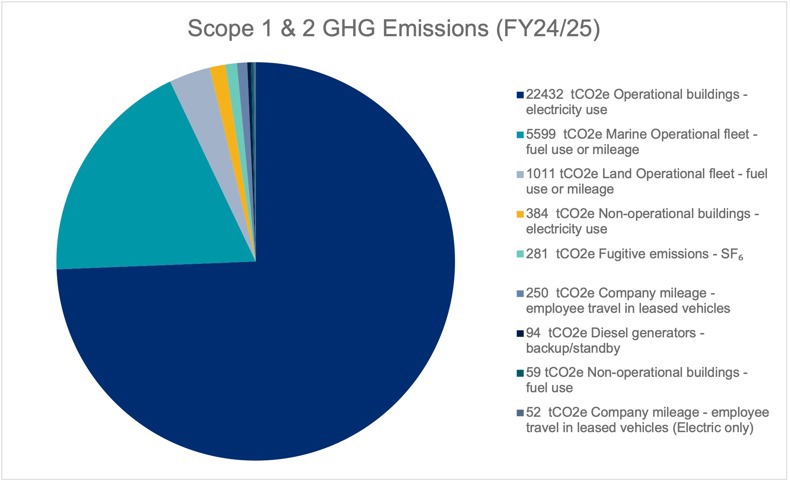
| Annual Sustainability Report KPIs | FY22/23 | FY23/24 | FY24/25 | |
|---|---|---|---|---|
| Scope 1 GHG Emissions | tCO2e | 13,876 | 4,289 | 7,295 |
| Scope 2 GHG Emissions | tCO2e | 5,949 | 22,867 | 22,868 |
| Scope 3 GHG Emissions (Modelled) | tCO2e | 1,319,356 | 1,295,954 | 1,113,170 |
| Scopes 1&2 GHG Intensity | tCO2e/GWh | 2.066 | 2.736 | 2.966 |
| Scope 3 GHG Intensity | tCO2e/MW in construction | 507 | 463 | 440 |